Showing posts with label David Mogolov. Show all posts

Tuesday, August 25, 2020

Inspiring The Show: David Mogolov on his show Eating My Garbage

 In this new series Inspiring The Show, I talk with solo performance creators about how they came up with the ideas for their shows. What was their inspiration and how did the process unfold as they crafted that original notion into a one-person show.

First up, David Mogolov and his 2014 show Eating My Garbage.


David Mogolov has been writing and performing comedic monologues in Boston since 2002. His shows are known for blending the personal and the political, and for smart, surprising insights that emerge through near-constant laugh lines. His shows include One Night at T.F. Green (2003 Single File Festival in Chicago), There Is No Good News (FRIGID New York 2011), and Dumber Faster (FringeNYC 2012) and Clenched (Dallas Solo Fest 2016). His work is published by Indie Theatre Now. 

His show Eating My Garbage finds David dumbfounded by a call from a political pollster who sounds suspiciously like Laura Linney. He searches himself for a reason to believe the nation isn't utterly doomed. When he can't quite think of one, he turns to irrational reasons. That's when his search gets more promising.

NYTheatreNow wrote of the show, that it:

...looks at the fragmented state of the Union with wit and intelligence and  a wry sensibility that blends the naive optimism and weathered cynicism that is so characteristic of American in the 21st century.

In his own words, here's David thoughts on how his show came about...

#   #   #

Eating My Garbage could have been a disaster of a show, but it came together mostly because I was open to taking new ideas into it and jettisoning the ones that were personally interesting but probably bad theater. One critical element of the show came as a complete surprise, a total coincidence that arrived when I wasn't even thinking about the show. 

But as far as the foundational ideas, they came from reading. Very often, I start with personal stories and explore the connections between them, but this time the ideas were very much "ideas" in the classic sense. I was working toward a show called Carry the Two, and the original concept is slightly muddled in my memory, perhaps because it was very muddled as a concept. I was trying to marry three different strands of thought:

1) For my previous show, Dumber Faster, I had done a lot of reading about psychology, particularly about how we make and justify our decisions. All of that reading was in my head, and many of my ideas at the time were rooted in that space.

2) For a few years, I'd wanted to look more at externalities, the economic idea that our activities have costs other than those we pay directly, costs that typically get pushed to society as a whole (pollution is the typical example).

3) Separate from that reading, I was really obsessed with the idea of tribalism. Everything in the news then (I was writing from late 2012 into late 2013) seemed to get stuck in these debates rooted in what best matched to our understanding of our group identities, which were shielding us from the hard work of owning our individual actions and inactions.

The problem is, I write and perform comedies that are rooted in personal stories, so I needed to anchor these things firmly in engaging, funny stories, rather than in lectures. For externalities, I had an easy surface-level comparison that I knew was funny, but I didn't think was personal enough to really build a show around: the smell of Subway sandwiches. Subway, simply by being in business, creates an externality in that the entire neighborhood around a Subway location takes on that odor.

The show ended up containing a nearly ten-minute comic bit about that smell. Perhaps it's absurd that about a fifth of the show was spent there, but on balance, it seems right. While the tribalism bit fell away entirely and the externalities element became very short, other psychological and cultural ideas crept in to give it all purpose, and offsetting that and contextualizing it in the ridiculous suited my style and brought the audience along. 

The other essential, fundamental element of the show was entirely unplanned—an uncanny coincidence (learning from my brother that he'd had a personal encounter with a celebrity at the center of the emerging narrative) allowed me to tighten the entire thing even more firmly into a personal narrative. It required a major structural change, introducing more personal stories, and jettisoning some more ideas I'd thought were important, but it absolutely created a better, tighter, more entertaining show that was much more humane and funny.

#   #   #

For more info on David and his solo shows, visit... HERE


#   #   #
Leave a comment. If you are a robot or a blatant marketer trolling Blogger, then you will be deleted. Humans only, please.
Wednesday, November 11, 2015

Books by Solo Performers I know...

The neat thing about many solo performers is that they are multi-talented artists. In this post I want to give a shout-out to three solo performers who have released books in the last year. I encourage you to check them out...

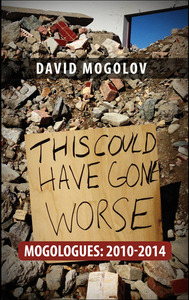
David Mogolov's This Could Have Gone Worse


David is a seasoned solo performe and has turned out quite a few dazzling monologues. He collected some of them together and the result is this hilarious and smart book.

Here's a blurb...

In 2010, David Mogolov began a series of three comedic monologues that left audiences questioning their life decisions small and large, from their flossing habits to their anger at Ponzi schemers. A hilarious, deep dive into the limits of human rationality, Mogolov’s comedy also presents history’s most thorough analysis of the smell of a Subway sandwich. 

In This Could Have Gone Worse, the trilogy of shows is annotated and expanded with commentary on how they were written and produced, with an honest account of what failed and what succeeded, and why. The notes and new chapters look at it from both the perspective of Mogolov and his director, Steve Kleinedler.

Get a copy for yourself... HERE


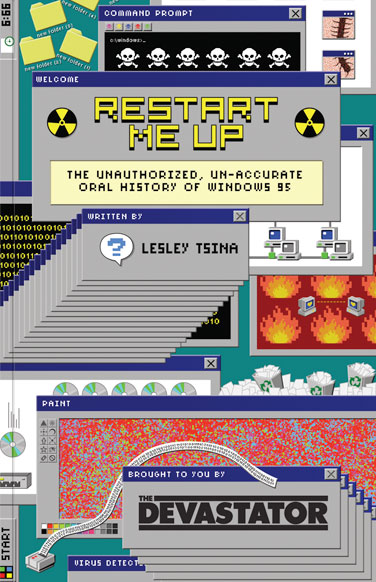
Lesley Tsina's Restart Me Up: The Unauthorized, Un-Accurate Oral History of Windows 95 


This is the untold, unbelievable, largely untrue story of the creation of Windows 95. Lesley tells it with her own special brand of deadpan wit.

Go behind the system and meet those who made it all possible: the beleaguered programmers who became addicted to snorting Pixy Stix, the marketers who employed mass hypnosis tactics to trick the press, the violent battle to squash a literal giant bug in the code, the focus group idiots who only cared about getting pizza for lunch, and "mighty god" Bill Gates, who engaged in a money suitcase stand-off with Mick Jagger over the rights to "Start Me Up." It's the story of how a tiny operating system patch became a multinational, mundane media phenomenon.

Get a copy of your own... HERE


Brad McEntire's I Brought Home a Chupacabra


Brad has performed many of his own shows. In this piece, he sets down a story for another performer.

In this weird and hilarious monologue, a young woman finds a semi-mythical beast on a hike and brings it home. During the next few days she is forced to figure out why it is that she connects better with animals than people. 

Get your copy... HERE


If you know of a few good books by solo performers, list 'em below in the comments. Spread the mirth...

Monday, April 7, 2014

Q-and-A with David Mogolov (repost)

This is a repost of a Q-and-A with David Mogolov here on TSP from December 14, 2012. He will be featured in the 2014 Dallas Solo Fest, presenting his new show Eating My Garbage. For more info visit... HERE.


I caught David Mogolov's show Dumber Faster at the 2012 New York International Fringe Festival. He and I were performing in the same venue. His show was funny, thoughtful and performed at a breakneck velocity. His presentation style echoes the Spaulding Gray/Mike Daisey approach (addressing the audience directly, as an audience, from behind a desk), but Mogolov definitely carves out his own idiosyncratic style. He is personable, professional and super-smart, but somehow is careful not to create the holier-than-thou distancing that can sometimes plague solo performers of the desk-and-talk style. He holds the subject he is exploring up and invites the audience to say "hey, you guys, just look at this..." right alongside him. 

He recently agreed to be interviewed for TheSoloPerformer.com, and I'm so glad he did.

Q: Please give us a brief bio, where you are from and how you started in theatre/performance?

A: I'm from Iowa, but was raised largely in Kansas, and then I moved to Boston for college and never left town. Though I did a tiny bit of theater in high school, most of my stage time back then was as a particularly untalented musician. I was in a band that wasn't very good but had schtick that went up to 11. So when college ended and a friend of mine recommended that I audition for a play, I wasn't really scared of the stage, and I was too ignorant of theater to know how much I didn't know. At his recommendation, I auditioned for a production of As Bees In Honey Drown, and got cast. The production was in many respects a fiasco (I surely bear a big load of the blame), but we had a really great pair of leads, and it's also where I met a fellow cast member, Steve Kleinedler, who subsequently became one of my closest friends.

  
That was in the spring of 2001. That Thanksgiving, I had this truly bizarre odyssey home to Boston from visiting relatives in Virginia, and I kept telling the story to friends, and obsessing over it, until one night my friend Zabeth, who was at that time booking a new comedy night at ImprovBoston, said, "You should tell this story on stage." To which I said, "People do that?" I needed a director, so I called Steve. The show, One Night at T.F. Green, got good audiences, a fortuitous little bit of press, and a second run. 11 years later, Steve and I still work together on every show, and I think I finally know what I'm doing. He's directed 5 of my solo shows, a dueling-monologue show with Sara Faith Alterman, and we wrote, produced, and performed more sketch comedy than seems plausible, on reflection. 


David Mogolov                                                                       [courtesy: Mogolov.com]

Q: What event or desire brought you specifically into the world of solo performance?


A: My dad, my brothers, and I watched pretty much every stand up comedy special that aired on TV between 1986 and 1996. To me, it was the single greatest thing a person could do, but I have to admit it never crossed my mind to do it. Although I heard and understood the "you can be anything you want" messages as a child, I don't think I internalized them until I hit 30 or so, by which time we usually figure out it's too late. But yeah, at the core of what I do is that childhood and teenage adoration of stand up comedy. Particularly George Carlin. And a solo show by Steven Banks called "Home Entertainment System" which, if there were any justice in this world, would be an enormous hit that everybody knows.


Q: Could you tell us about some of your solo work?

A: Well, the first show, One Night at T.F. Green, was a mostly-true account of my night at the airport in Warwick, Rhode Island. I attempted to tell the story close to accurately, both in storytelling and through playing many of the people I met. Though I think it was a good show, and the audiences really liked it, it was also a huge opportunity for me to make some mistakes that I could learn from. Each show since has gotten better, and with the last two, There Is No Good News and Dumber Faster, I've found a style that seems to suit me.


Q: How would you describe your particular kind of solo performance?
 

David Mogolov in DUMBER FASTER                                  [via: indietheaternow.com]
A: I sometimes think of it as theatrical comedic essay. The best essays end up in places their sources don't obviously point to, and reading them is constantly surprising, but on reflection, it's all completely logical. That's what I try to do with my shows. I want to take the audience from a set of basic claims and observations to a place that is undeniably true but totally unexpected. So I start quietly, telling stories and talking about current events and psychology and economics, and I throw out more and more and more until it's a big interconnected mess, and then I pull it all together, because I honestly hate messes. I try to layer in the joke density of stand up comedy, so that all the way through the audience is laughing. 

Q: What is your favorite thing about doing this work?

A: The first laugh of the show. That's my absolute favorite thing. It should arrive at a particular moment, and when it does, it's just fantastic. Nothing compares. Then I can stop worrying and lose myself in the show. 


Q: What inspires you to keep going and how do you keep yourself motivated?


A: Motivation is hard. I'm a procrastinator, but one wracked by guilt. I wish I could procrastinate without dread. As a practical matter, I motivate myself by setting deadlines and making them public. Even if nobody's really watching, announcing that I'll have a first draft by New Year's forces me to do it. The only thing that overpowers my laziness is my shame. So I have to do it.


As for inspiration, I guess there comes a point between shows where I've been reading, and listening to the radio, and hearing friends talk, and my brain catches on a little wrinkle, a bit of cognitive dissonance or a little warp in the logic of the universe that I keep coming back to. With There Is No Good News, it was this financial crisis that exposed deeper problems with how we live than we were acknowledging even in the depth of it. With Dumber Faster, it was the double life we live, the public and private selves, the way we're not acting in our own interest, and doing it so publicly. I get hooked on some idea, and I can't stop poking at it, and at some point I consciously realize that I've already got the core of a show. So then I set that public deadline. 


Q: What is your approach to the development process when putting together a new project? Do you create a lot on stage, improvising? More on paper? Tape or video record? Hold readings? Go to a mountain top?

A: For starters, I can honestly say that I don't know what I think about something until I've tried to write my way through it. And that's true of these shows. While a ton of great stuff comes out of rehearsal, and new jokes get found on the stage, I'm am fundamentally a writer. I don't know any other way.


When I'm about to start a show, I tell Steve [
Kleinedler, the director], and I give him a date to expect a draft. Then I tweet it or put it on Facebook or something. When sit down to write, it's with that topic I'm struggling with, something that is fascinating and current, that allows me to be critical and self-critical, and that's broad enough to hook a lot of stories to. By the time I know "this is the one" I've already got one or two elements that I know are at the core of it, and I start with them, just writing without agenda. I write TERRIBLE first drafts. They're humorless rants with barely relevant anecdotes hooked onto them. But I beat that draft into a better shape, and then send it to Steve, who is the only person who sees those terrible drafts. And he gives me constructive advice. A lot of fundamental questions. He'll notice rhetorical patterns in the draft that I hadn't caught. We don't even read that one aloud, because it lacks anything like the cadence or humor I want to bring to the stage. I wait a couple weeks, and then go back to it with a fresh mind. The second draft is a gutting of that original. With Dumber Faster, I'd bet I deleted over half of it entirely, and the stuff that got cut wasn't without value, it just didn't fit around the new center of the show, which I think I've identified. Each subsequent draft for awhile moves that center, ties the pieces around it tighter, introduces new complexities and tries to resolve them. By draft seven or eight, Steve and I are reading weekly, and we then usually bring in a cold reader to read it to us. Then I gut it again, and build it up again. The stage version of Dumber Faster was 17. Between 7 and 17, we had one staged reading (draft 12). It's painful cutting scenes and jokes I like, but I've never looked back at an old draft and thought it was better. I know this process works for me.

David Mogolov performing EATING MY GARBAGE

Q: Who are some of your influences or people that inspire/embolden you?
 
A: Novelists and essayists. I'm rereading Myla Goldberg's Bee Season right now. That book is kicking my ass. The depth of the characters is incredible, and she has these little scenes that are seismic. A brother and sister sitting on a couch not talking. If I wrote that scene, it would be that last sentence, that sentence fragment. Hers is an atom bomb. 
 

Halfway through Dumber Faster, I started watching the British comic Stewart Lee. I watched what I could online and then bought everything I could of his from a record company in Wales, and while I don't think our styles are anything alike, your word "embolden" is completely apt. Everything I was just about to say, I now had to say. His shows are incredible
 

Q: How do you bridge the gap of the business side of theatre?


A: Oh man. I guess I bridge it by falling into the ravine. I have this dream of ending up in the black someday, but I'm a 9-to-5er. I'm fortunate to have made a career that is interesting and ethical with a company that gives me the flexibility to keep doing theater and comedy. I guess because I came to it slowly and without a plan, I've remained shocked that I get to do this at all, and so the fact that I'm woefully negligent in looking after my own business interests doesn't keep me up at night.
 

Q: Any advice for some aspiring artist just starting out in solo performance?

A: Two things come to mind: be ruthlessly honest with yourself and find a director or an advisor who will do the same. Most people will not tell you the truth, they will tell you what is easiest to say that will encourage you. Encouragement is valuable, but it doesn't push you to make good theater or comedy. Look at your own material the way you'd look at the work of a rival. Pick it apart. Write a scathing review of it in your mind. When you revise, when you rehearse, address those problems. Because you're not the only one who will think of them. You're just the only one who can do anything about them before it's too late.


The other thing I'd say is, if you're dealing with true stories, you don't have to tell every detail. Just because it's true doesn't mean it's theater. Pick the elements that make for good theater, and save the rest. If you stopped for lunch between the two critical events, you're not morally obligated to reveal the lunch. Your first obligation is to captivate, entertain, and challenge the audience. You can do that, ethically, without presenting a diary.
 

Q: Share with us something funny that has happened to you recently.

A: I have a sort of compulsive personality, and on a lark, I started writing fictional biographies of my friends on Facebook. It turned out to be a good writing exercise, and really fun, and one thing led to another, and six weeks later, I'd written 100 of them. I hadn't really intended to take on a new project like that at all, but because I'm an idiot with no time management skills, I wrote about 50,000 words of biography in less than two months, putting aside almost everything else. The response has been really positive, so I put them all on a site: Unauthorized Facebook Biography
 

Q: What do you see for the future of solo performance and for you personally as an artist?
 

A: More generally, I think everybody's ability to see anything and learn anything at any time will expose more people to solo performance and lead to a lot of technical innovation. We'll see a lot of spectacular weirdness. While it's harder than ever to do anything at a huge level, I see increasing opportunities to find rewarding and valuable communities in niches. Nothing has to be a hit to be viable. That's my hope. 

Personally, I'm starting another show. I've identified the topic I can't shake, so I'm just about to set a deadline and get to work. First though, I'm retiring Dumber Faster in grand style. The details are still getting worked out, but in March we're going to run it as a charity show for an awesome organization that still needs me to sign some paperwork before I should use their name publicly [Update: the benefit was for Doctors Without Borders] . We're going to record it and make it available for download for a $5 charitable contribution. I'm not seeing a penny from it. I should have details public in January 2013!


More information about David Mogolov and his work at: www.mogolov.com 

For info about his show EATING MY GARBAGE at the Dallas Slo Fest... HERE.

Monday, March 17, 2014

Dallas Solo Fest Kickstarter


Dallas, Texas is getting its very own solo performance festival... The Dallas Solo Fest.

There's a Kickstarter going on presently to help fund the first one. It looks like this first year, it is curated and by invitation, but if it goes over successfully, in the future it will be a full-fledge fringe-sque festival with open submissions for solo performers.

Kickstarter info HERE (closes March 24th... act fast!)

Festival website HERE.

Friday, December 14, 2012

Q-and-A with David Mogolov


David Mogolov                                                         from mogolov.com

I caught David Mogolov's show Dumber Faster at the New York International Fringe Festival last August. He and I were performing in the same venue. His show was funny, thoughtful and performed at a breakneck velocity. His presentation style echoes the Spaulding Gray/Mike Daisey approach (addressing the audience directly, as an audience, from behind a desk), but Mogolov definitely carves out his own idiosyncratic style. He is personable, professional and super-smart, but somehow is careful not to create the holier-than-thou distancing that can sometimes plague solo performers of the desk-and-talk style. He holds the subject he is exploring up and invites the audience to say "hey, you guys, just look at this..." right alongside him. 

He recently agreed to be interviewed for TheSoloPerformer.com, and I'm so glad he did.


Q: Please give us a brief bio, where you are from and how you started in theatre/performance?

A: I'm from Iowa, but was raised largely in Kansas, and then I moved to Boston for college and never left town. Though I did a tiny bit of theater in high school, most of my stage time back then was as a particularly untalented musician. I was in a band that wasn't very good but had schtick that went up to 11. So when college ended and a friend of mine recommended that I audition for a play, I wasn't really scared of the stage, and I was too ignorant of theater to know how much I didn't know. At his recommendation, I auditioned for a production of As Bees In Honey Drown, and got cast. The production was in many respects a fiasco (I surely bear a big load of the blame), but we had a really great pair of leads, and it's also where I met a fellow cast member, Steve Kleinedler, who subsequently became one of my closest friends.

 
That was in the spring of 2001. That Thanksgiving, I had this truly bizarre odyssey home to Boston from visiting relatives in Virginia, and I kept telling the story to friends, and obsessing over it, until one night my friend Zabeth, who was at that time booking a new comedy night at ImprovBoston, said, "You should tell this story on stage." To which I said, "People do that?" I needed a director, so I called Steve. The show, One Night at T.F. Green, got good audiences, a fortuitous little bit of press, and a second run. 11 years later, Steve and I still work together on every show, and I think I finally know what I'm doing. He's directed 5 of my solo shows, a dueling-monologue show with Sara Faith Alterman, and we wrote, produced, and performed more sketch comedy than seems plausible, on reflection. 


Q: What event or desire brought you specifically into the world of solo performance?

A: My dad, my brothers, and I watched pretty much every stand up comedy special that aired on TV between 1986 and 1996. To me, it was the single greatest thing a person could do, but I have to admit it never crossed my mind to do it. Although I heard and understood the "you can be anything you want" messages as a child, I don't think I internalized them until I hit 30 or so, by which time we usually figure out it's too late. But yeah, at the core of what I do is that childhood and teenage adoration of stand up comedy. Particularly George Carlin. And a solo show by Steven Banks called "Home Entertainment System" which, if there were any justice in this world, would be an enormous hit that everybody knows.


Q: Could you tell us about some of your solo work?

A: Well, the first show, One Night at T.F. Green, was a mostly-true account of my night at the airport in Warwick, Rhode Island. I attempted to tell the story close to accurately, both in storytelling and through playing many of the people I met. Though I think it was a good show, and the audiences really liked it, it was also a huge opportunity for me to make some mistakes that I could learn from. Each show since has gotten better, and with the last two, There Is No Good News and Dumber Faster, I've found a style that seems to suit me.


Q: How would you describe your particular kind of solo performance?
 

A: I sometimes think of it as theatrical comedic essay. The best essays end up in places their sources don't obviously point to, and reading them is constantly surprising, but on reflection, it's all completely logical. That's what I try to do with my shows. I want to take the audience from a set of basic claims and observations to a place that is undeniably true but totally unexpected. So I start quietly, telling stories and talking about current events and psychology and economics, and I throw out more and more and more until it's a big interconnected mess, and then I pull it all together, because I honestly hate messes. I try to layer in the joke density of stand up comedy, so that all the way through the audience is laughing.

Q: What is your favorite thing about doing this work?

A: The first laugh of the show. That's my absolute favorite thing. It should arrive at a particular moment, and when it does, it's just fantastic. Nothing compares. Then I can stop worrying and lose myself in the show. 


Q: What inspires you to keep going and how do you keep yourself motivated?


A: Motivation is hard. I'm a procrastinator, but one wracked by guilt. I wish I could procrastinate without dread. As a practical matter, I motivate myself by setting deadlines and making them public. Even if nobody's really watching, announcing that I'll have a first draft by New Year's forces me to do it. The only thing that overpowers my laziness is my shame. So I have to do it.


As for inspiration, I guess there comes a point between shows where I've been reading, and listening to the radio, and hearing friends talk, and my brain catches on a little wrinkle, a bit of cognitive dissonance or a little warp in the logic of the universe that I keep coming back to. With There Is No Good News, it was this financial crisis that exposed deeper problems with how we live than we were acknowledging even in the depth of it. With Dumber Faster, it was the double life we live, the public and private selves, the way we're not acting in our own interest, and doing it so publicly. I get hooked on some idea, and I can't stop poking at it, and at some point I consciously realize that I've already got the core of a show. So then I set that public deadline.


Q: What is your approach to the development process when putting together a new project? Do you create a lot on stage, improvising? More on paper? Tape or video record? Hold readings? Go to a mountain top?

A: For starters, I can honestly say that I don't know what I think about something until I've tried to write my way through it. And that's true of these shows. While a ton of great stuff comes out of rehearsal, and new jokes get found on the stage, I'm am fundamentally a writer. I don't know any other way.


When I'm about to start a show, I tell Steve [
Kleinedler, the director], and I give him a date to expect a draft. Then I tweet it or put it on Facebook or something. When sit down to write, it's with that topic I'm struggling with, something that is fascinating and current, that allows me to be critical and self-critical, and that's broad enough to hook a lot of stories to. By the time I know "this is the one" I've already got one or two elements that I know are at the core of it, and I start with them, just writing without agenda. I write TERRIBLE first drafts. They're humorless rants with barely relevant anecdotes hooked onto them. But I beat that draft into a better shape, and then send it to Steve, who is the only person who sees those terrible drafts. And he gives me constructive advice. A lot of fundamental questions. He'll notice rhetorical patterns in the draft that I hadn't caught. We don't even read that one aloud, because it lacks anything like the cadence or humor I want to bring to the stage. I wait a couple weeks, and then go back to it with a fresh mind. The second draft is a gutting of that original. With Dumber Faster, I'd bet I deleted over half of it entirely, and the stuff that got cut wasn't without value, it just didn't fit around the new center of the show, which I think I've identified. Each subsequent draft for awhile moves that center, ties the pieces around it tighter, introduces new complexities and tries to resolve them. By draft seven or eight, Steve and I are reading weekly, and we then usually bring in a cold reader to read it to us. Then I gut it again, and build it up again. The stage version of Dumber Faster was 17. Between 7 and 17, we had one staged reading (draft 12). It's painful cutting scenes and jokes I like, but I've never looked back at an old draft and thought it was better. I know this process works for me.

Q: Who are some of your influences or people that inspire/embolden you?
 
A: Novelists and essayists. I'm rereading Myla Goldberg's Bee Season right now. That book is kicking my ass. The depth of the characters is incredible, and she has these little scenes that are seismic. A brother and sister sitting on a couch not talking. If I wrote that scene, it would be that last sentence, that sentence fragment. Hers is an atom bomb. 

Halfway through Dumber Faster, I started watching the British comic Stewart Lee. I watched what I could online and then bought everything I could of his from a record company in Wales, and while I don't think our styles are anything alike, your word "embolden" is completely apt. Everything I was just about to say, I now had to say. His shows are incredible


Q: How do you bridge the gap of the business side of theatre?


A: Oh man. I guess I bridge it by falling into the ravine. I have this dream of ending up in the black someday, but I'm a 9-to-5er. I'm fortunate to have made a career that is interesting and ethical with a company that gives me the flexibility to keep doing theater and comedy. I guess because I came to it slowly and without a plan, I've remained shocked that I get to do this at all, and so the fact that I'm woefully negligent in looking after my own business interests doesn't keep me up at night.


Q: Any advice for some aspiring artist just starting out in solo performance?

A: Two things come to mind: be ruthlessly honest with yourself and find a director or an advisor who will do the same. Most people will not tell you the truth, they will tell you what is easiest to say that will encourage you. Encouragement is valuable, but it doesn't push you to make good theater or comedy. Look at your own material the way you'd look at the work of a rival. Pick it apart. Write a scathing review of it in your mind. When you revise, when you rehearse, address those problems. Because you're not the only one who will think of them. You're just the only one who can do anything about them before it's too late.


The other thing I'd say is, if you're dealing with true stories, you don't have to tell every detail. Just because it's true doesn't mean it's theater. Pick the elements that make for good theater, and save the rest. If you stopped for lunch between the two critical events, you're not morally obligated to reveal the lunch. Your first obligation is to captivate, entertain, and challenge the audience. You can do that, ethically, without presenting a diary.


Q: Share with us something funny that has happened to you recently.

A: I have a sort of compulsive personality, and on a lark, I started writing fictional biographies of my friends on Facebook. It turned out to be a good writing exercise, and really fun, and one thing led to another, and six weeks later, I'd written 100 of them. I hadn't really intended to take on a new project like that at all, but because I'm an idiot with no time management skills, I wrote about 50,000 words of biography in less than two months, putting aside almost everything else. The response has been really positive, so I put them all on a site: Unauthorized Facebook Biography


Q: What do you see for the future of solo performance and for you personally as an artist?
 

A: More generally, I think everybody's ability to see anything and learn anything at any time will expose more people to solo performance and lead to a lot of technical innovation. We'll see a lot of spectacular weirdness. While it's harder than ever to do anything at a huge level, I see increasing opportunities to find rewarding and valuable communities in niches. Nothing has to be a hit to be viable. That's my hope. 

Personally, I'm starting another show. I've identified the topic I can't shake, so I'm just about to set a deadline and get to work. First though, I'm retiring Dumber Faster in grand style. The details are still getting worked out, but in March we're going to run it as a charity show for an awesome organization that still needs me to sign some paperwork before I should use their name publicly. We're going to record it and make it available for download for a $5 charitable contribution. I'm not seeing a penny from it. I should have details public in January 2013!


More information about David Mogolov and his work at: www.mogolov.com