Sunday, February 7, 2016

Bogosian/ Daisey Conversation

Eric Bogosian and Mike Daisey
Monologuists Mike Daisey and Eric Bogosian sit down for a sort of mutual interview for the American Theatre Magazine podcast Off Script.

There are some real nuggets of wisdom as the two discuss why they do solo performance and why they dislike seeing solo performance sometimes.

They touch on two things I have been thinking about lately... 

First, what is solo performance, as a career, for? Bogosian seems to express that it is its own thing and both he and Daisey bemoan the concept of it being a "vehicle" for an actor to move onto something else. But, Bogosian is practically retired from solo work, having performed the last of his solos a decade and half ago (outside his one-shot performances to promote his recent 100 Monologues book, thus why he is being covered in the press right now). He admits to having done as much television and film work as he ever performed in the theatre by this point in his career. Daisey admits to continually growing restless and striving to push the limits of the specific solo form he does (i.e. guy at a desk telling interconnected narratives).

I had a discussion with a programmer of a major U.S. performing arts center a few month ago and he flat out asked me what the end goal of my adventures of solo performance would be. I did not have an answer. I have been performing solo works for the last five years as just another way to express myself as a theatre artist. Until recently, I never really thought about solo performance as a "career." But why not? 

Solo performance is still a sub-arcana of an already barely-in-the-mainstream art form (Theatre). So what does the mountaintop look like for that? What does a successful solo performance career look like? Is there even such a thing as a successful "solo performance career?" Who would we look to as an example of someone who has made it?

Is it TJ Dawe... who conquered the fringe circuit for a decade, perfoming to sell-out audiences across Canada, but is otherwise unknown outside fringe circles? Is it Mike Daisey... moving beyond fringe fests, playing at the Public, getting interviewed by mainstream press (and experiencing NPR-level public scandals), pushing the barriers of duration, and touring to performing arts centers and regional theatres to be the subscriber add-on show? Though that is well beyond the fringe-level I currently operate at (even Dawe's level recognition is higher than my current status), that is still a pretty low level of notoriety and impact. Or is it Bogosian, or Goldberg, or Tomlin, or Leguizamo... all of whom used their solo shows as springboards into other media, most prominently television and motion pictures. In this latter example, solo performance is just a bridge to other pursuits, not the end run.

My theory is, until we see solo performances being performed in stadiums (like some mega-successful comedians) or perhaps a return to the Ruth Draper days when very large fees could be had for very exclusive limited engagements at places like the Royal Albert Hall, I don't think solo performance is, as it is, the ultimate culmination of a performer's career. Maybe it is a stepping stone to other kinds of performance. 

The other thing the conversation between the two makes me wonder about is the small, but noticeable fact that Daisey keeps referring to "solo performance" and to "theatre." The implication is that they are separate.

I consider solo performance to actually be a form of theatre. It fulfills whatever definition of theatre one wants to apply to it, whether it is Aristotle's six elements (even if some, like Daisey's works, for instance, almost completely dispense with Spectacle altogether) or Peter Brook taking an empty space and having someone watch someone else walk across it. 

In the conversation, this is touched on indirectly when they riff on how critics respond to solo shows... initially loathe to go, but sometimes begrudgingly admitting it was surprisingly engaging. Why should a reviewer be any more wary of a show with one person than a show with fifteen? Is the risk for the audience different? Is there a difference in percieved quality? 'Cause I have seen multi-actor theatre productions that have been shitty and I have seen some that were great... just as much as I have seen some solo works that are shitty and some that are great. Either way, both are theatre.

Anyway, the conversation is well worth a listen or two. It gets going around the 18:40 minute mark. Feel free to leave a comment below for any bits and pieces you might pick up from it.

Here's the link... http://www.americantheatre.org/2016/01/29/offscript-eric-bogosian-and-mike-daiseys-wild-ride/

ALSO: Bogosian will be performing a selection of his monologues in Dallas at the AT&T Performing Arts Center, Feb 11-13, 2016... Click here for TIX.


Saturday, January 23, 2016

Q-and-A with Antonio Sacre

Antonio Sacre [photo by Dixie Sheridan]

I first saw Antonio perform at the Phoenix Fringe back in 2010(ish). Super engaging performer. I am thrilled he agreed to answer a few questions for TSP.com


Q: Please give us a brief bio, where you are from and how you started in theatre/performance?

A: I was born in Boston to a Cuban father and Irish-American mother.  I was raised in Delaware, where I discovered theater in high school.  I was too scared to pursue it in college, so I got an English degree but did plenty of university theater.  I finally got the courage to pursue theater after graduation and went to Northwestern University and got a Masters in Theatre.  During the program, I studied storytelling, acting, and solo performance, and discovered solo performers Spalding Gray, John Leguizamo, and Anna Deavere Smith.  I was fortunate to be mentored in Chicago by incredible storytellers and solo performers.


Q: What event or desire brought you specifically into the world of solo performance?

A: My first exposure was watching Spalding Gray live and the world opened to me.  When I saw John Leguizamo perform in English and Spanish, though, I shifted all of my attention to solo performance.


Q: Could you tell us about some of your particular kind of of solo work?

A:
I’ve created 10 full-length solo shows (between 60-80 minutes each).  Half of them are autobiographical, where I play different characters from my family, very influenced by John Leguizamo.  The other half are characters I have created that explore specific topics in detail.


Q: What is your favorite thing about doing this work?


A:The challenge of holding an audience’s attention for 60 minutes in today’s world is nearly impossible.  It’s very demanding of the audience and the performer, and when it works it’s spectacular.  When it doesn’t work, it’s incredibly painful (or worse) for all involved.  I’ve had a lot of both, slightly more of the former than the latter.  That magical moment at the end of a performance that actually worked can’t be duplicated in any other way that I know of.


Q: What inspires you to keep going and how do you keep yourself motivated?

A:
The most important thing that I do to keep myself motivated is to work with a director.  He or she will give me assignments to write about, tell me about solo shows I should be watching, and generally hold my feet to the fire.  My two most successful collaborations have been with Jenny Magnus of Curious Theatre Branch in Chicago, and I am currently working on my fourth full-length show with Paul Stein in Hollywood CA.


Q: What is your approach to the development process when putting together a new project? 
Do you create a lot on stage, improvising? More on paper? Tape or video record? Hold readings? Go to a mountain top?

A: Nine of my ten shows started entirely on paper.  I then did readings of the first draft to my directors, who then told me what they thought I was trying to say.  This was almost always not what was on the page.  I would then rewrite based on their notes and bring in the second draft.  Six times I heard that I had kept all of the bad stuff and didn’t incorporate anything that they had said, and once Paul Stein told me, “That shit might work with your mom, but it sure won’t play with me.”  Lastly, I do extended runs of early drafts at fringe festivals around the country, mostly in Chicago, Hollywood, New York, and San Francisco, but also including places like Washington DC and Phoenix.


Q: Who are some of your influences or people that inspire you?

A:
Danny Hoch, Will Power, and Sara Jones are huge influences on my work.  The Wooster Group of the 1970s and of today continues to inspire me.  In the storytelling world, Jim May and Bill Harley are mentors and friends.


Q: How do you bridge the gap betwwen the creative and the business side of solo theatre?

A:
Solo performance is a purely creative activity for me, and the business side of it doesn’t factor in at all.  However, I make a living as a storyteller and children’s book author, something that my solo career has helped facilitate.  One example is that I got my literary agent, who helped me sell my children’s books, after she saw one of my solo performances in New York City.


Q: Any advice for some aspiring artist just starting out in solo performance?

A:
Deadlines are crucial, and the best way I know to give myself a deadline is to apply to a fringe festival.  There are now fringe festivals all around the world and they’re wonderful places to do and see theater.  Secondarily, get a director.  Please get a director.


Q: What do you see for the future of solo performance and for you personally as an artist?

A: The cost of doing theater for major theater companies across the country can be prohibitive, and solo performances can be a great way to make ends meet for theater companies (if the product is spectacular).  As I write this, Hal Holbrook is remounting his famous Mark Twain solo performance as a benefit in Hollywood for $500/ticket.  However, it seems that solo performance has also become celebrity-driven.  Danny Hoch got on HBO before he was famous; that doesn’t seem possible now.  I had been performing solo performances in Hollywood for the last 10 years and recently have had producers, agents, and managers interested in trying to turn my solo performances into TV series.


Q: Shout outs or links?

A: Five of my solo plays have been published and are available on IndieTheaterNow.com(http://www.indietheaternow.com/Playwright/antonio-sacre).  It’s one of my absolute favorite spots for discovering new theater.  My website is antoniosacre.com.  Oh yeah, there's my twitter and Instagram @antoniosacre and Antonio Sacre on FB. Shout out to the amazing Paul Stein, who just held my feet to the fire in rehearsal last week as we start the journey anew.


Thursday, December 10, 2015

Own a bit of Ruth Draper


Dear Ruth Draper friends and fans,
It’s been fifteen years since recordings by the incomparable Ruth Draper bounced back into circulation in new CD versions. Celebrate that anniversary, and Draper’s 131st birthday, by spreading the word -- because the very best way to keep Draper’s monologues alive is to introduce them to new admirers. And what better time than the holidays? As the Society Matron in “The Italian Lesson” observed of the Philharmonic: “Oh, lord, it seems to come so often!” Indeed, but make those pesky holidays a pleasure, not a chore, by giving Ruth Draper CDs to everyone on your list.
Enjoy the season, and thanks for helping to keep Draper’s work alive.
Cheers,
Susan Mulcahy

Wednesday, November 11, 2015

Books by Solo Performers I know...

The neat thing about many solo performers is that they are multi-talented artists. In this post I want to give a shout-out to three solo performers who have released books in the last year. I encourage you to check them out...

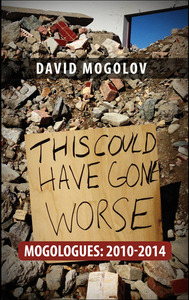
David Mogolov's This Could Have Gone Worse


David is a seasoned solo performe and has turned out quite a few dazzling monologues. He collected some of them together and the result is this hilarious and smart book.

Here's a blurb...

In 2010, David Mogolov began a series of three comedic monologues that left audiences questioning their life decisions small and large, from their flossing habits to their anger at Ponzi schemers. A hilarious, deep dive into the limits of human rationality, Mogolov’s comedy also presents history’s most thorough analysis of the smell of a Subway sandwich. 

In This Could Have Gone Worse, the trilogy of shows is annotated and expanded with commentary on how they were written and produced, with an honest account of what failed and what succeeded, and why. The notes and new chapters look at it from both the perspective of Mogolov and his director, Steve Kleinedler.

Get a copy for yourself... HERE


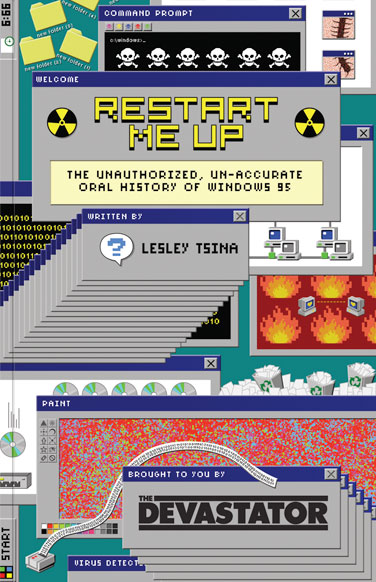
Lesley Tsina's Restart Me Up: The Unauthorized, Un-Accurate Oral History of Windows 95 


This is the untold, unbelievable, largely untrue story of the creation of Windows 95. Lesley tells it with her own special brand of deadpan wit.

Go behind the system and meet those who made it all possible: the beleaguered programmers who became addicted to snorting Pixy Stix, the marketers who employed mass hypnosis tactics to trick the press, the violent battle to squash a literal giant bug in the code, the focus group idiots who only cared about getting pizza for lunch, and "mighty god" Bill Gates, who engaged in a money suitcase stand-off with Mick Jagger over the rights to "Start Me Up." It's the story of how a tiny operating system patch became a multinational, mundane media phenomenon.

Get a copy of your own... HERE


Brad McEntire's I Brought Home a Chupacabra


Brad has performed many of his own shows. In this piece, he sets down a story for another performer.

In this weird and hilarious monologue, a young woman finds a semi-mythical beast on a hike and brings it home. During the next few days she is forced to figure out why it is that she connects better with animals than people. 

Get your copy... HERE


If you know of a few good books by solo performers, list 'em below in the comments. Spread the mirth...

The Whole Widget

"Mr. Daisey, who gave a talk titled “Why Solo Performance Matters,” contends solo performers are the last vanguard of independent artists in a corporatized theatrical landscape. And this, more than the economy or any other factor, has propelled the rise of solo performances. “It’s becoming more difficult to get any work produced,” Mr. Daisey said. “At the end of the day, many people realize that they have only themselves to count on. It’s a form where the whole widget can be controlled.”

from a New York Times article entitled "Getting a Little Help to go Out All Alone"

Monday, November 9, 2015

Robert Michael Oliver on The Incredible Shrinking Ensemble: Is Solo Performance Theatre’s Future?

Kathleen Turner in Philadelphia Theatre Company’s
production of Red Hot Patriot The Kick-a*s Wit of Molly Ivins.
Photo by Mark Gavin.

In an article posted on the MDTheatreGuide.com a few years ago, Robert Michael Oliver wrote an interesting piece about the rise of solo performance in the theatre. He hypothesized it to be the future of regional theatre...

[The] emergence [of solo performance] as a presence at mid-sized theatres, however, is most likely a harbinger of things to come. 

Though the entire article is implicitly aimed at deriding solo performance as actual theatre, he makes several strong points. It is worth looking at, even if to see what you may or may not agree with...

The audience can listen attentively and imagine their significance and what they must have been like, but within the frame of the one-person performance those scenes cannot affect us emotionally the way drama does.

Check it out... HERE


Sunday, November 8, 2015

SOLO forum in the UK

UK-based solo performers:

Something to check out... now around ten years in existence, the SOLO Contemporary Performance forum seems to be a great resource. From the site:
It offers practical, artistic, financial and production support to regional, national and international solo performance makers via several platforms, including artists’ laboratories, residencies, scratch and showcase events, public interviews and a new website. It was founded by Misri Dey in 2005, who works as artistic director, with Ria Hartley as the co-ordinator of the Bristol group.

Give it a look over... HERE